
Why Closed-Loop Stepper Motors Don’t Lose Steps (Closed-Loop & Integrated Motors, Part 1)
Step loss is one of the most elusive failures in open-loop motion control. This is Part 1 of our “Closed-Loop & Integrated Motor” series: we walk through the mechanism of step loss, how closed-loop compensation is implemented, an open-loop vs. closed-loop selection comparison, and a troubleshooting approach for sudden load changes — helping engineers judge when it is worth upgrading to a closed-loop solution for step-loss-free positioning.
How Step Loss Actually Happens
A stepper motor positions by step angle: every pulse the driver receives switches the winding currents in a preset sequence, advancing the magnetic field one step, and the rotor follows under the field’s pull. In pure open-loop mode the driver simply switches current pulse by pulse; the system assumes “the rotor moves exactly as many steps as the pulses sent” and has no way of knowing whether the rotor actually kept up.
At its core, step loss means the synchronous pull between rotor and magnetic field has broken down. Available torque is never constant: the higher the speed and the steeper the acceleration or deceleration, the smaller the dynamic torque; a low supply voltage slows current build-up, further shrinking torque at high speed. Once the load torque — friction plus inertia — exceeds the torque available at the current speed, the rotor lags behind or even judders backward. Resonance is another common trigger: near the motor’s natural oscillation frequency, rotor lag is amplified cycle after cycle.
Worse still is the missing feedback: an open-loop system never raises an alarm, so the error keeps accumulating until the next homing cycle exposes it — and in the meantime the machine may keep machining or handling parts at the wrong coordinates.
Encoder Closed-Loop Compensation: From “I Assume” to “I Know”
A closed-loop stepper typically adds an encoder at the rear of the motor, usually incremental or absolute. The encoder streams rotor angle and position in real time, and the driver derives actual position, speed and direction from it — effectively giving the system eyes on “how far the rotor has really moved.” Incremental encoders require re-homing after a power cycle; absolute encoders remember position.
Inside the driver, three nested loops work together. The position loop compares commanded position with feedback — “how many steps short are we?” The velocity loop turns the error into a target speed — “how fast do we catch up?” The current loop controls winding current magnitude and phase so the motor produces exactly the torque needed. The three loops are nested layer by layer and iterate in millisecond-scale cycles.
At the execution level, compensation runs in three steps. Error detection: any mismatch between commanded and fed-back position immediately creates a position error that is updated continuously. Dynamic compensation: the driver raises current and corrects commutation according to the error’s direction and magnitude, briefly slowing or pausing if needed so the rotor can catch back up. Over-limit protection: if the error exceeds a configured threshold, the driver alarms, stops or flags an in-position fault according to its strategy — instead of “pretending the move finished.”
Closed-Loop vs. Pure Open-Loop: More Than Just an Encoder
The strengths of pure open-loop steppers still stand: simple structure, low cost, easy commissioning — still a practical choice where loads are steady, speeds are moderate and positioning demands are relaxed. But open-loop rests position accuracy on the assumption that the motor never loses steps. A closed-loop stepper turns that assumption into real-time verification — motion still follows pulses or bus commands, yet the driver regulates current from feedback: lower current under light load to cut heat and noise, a rapid boost under heavy load to strengthen disturbance rejection.
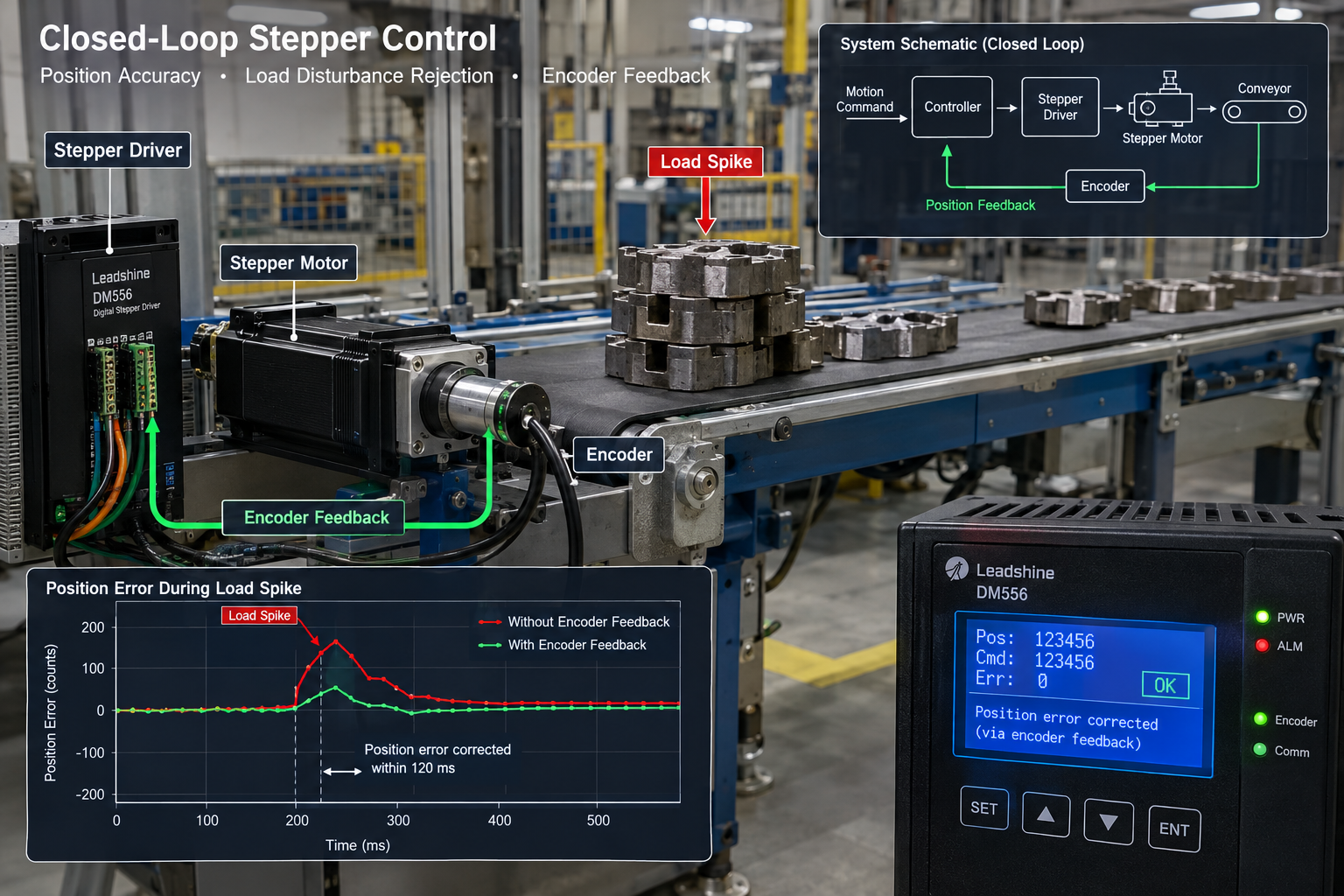
Another difference is observability: an open-loop system only ever knows commanded position, never actual position. A closed-loop system continuously outputs position error, current, speed and other status data, making it much easier to tell whether the cause is mechanical binding, an abnormal load, or unreasonable parameters. For selection, refer to the table below:
| Comparison Aspect | Pure Open-Loop Stepper | Closed-Loop Stepper |
|---|---|---|
| Position accuracy | Relies on the “no step loss” assumption; no error feedback | Real-time compensation; alarms once limits are exceeded |
| Heat and noise | Current set for worst-case conditions | Adjusted dynamically with load — quieter and more efficient at light load |
| Sudden load response | Unaware; position drifts silently | Compensates first, then alarms — faults visible and controllable |
| Commissioning and diagnostics | Current and accel/decel tuned by experience | Error, current and speed states can be read out |
For procurement decisions: a closed-loop stepper is not a one-for-one servo replacement — it fills the reliability and energy-efficiency gaps within the stepper family, and suits equipment that wants to keep familiar stepper control habits while gaining far higher certainty.
Sudden Load Changes: How Closed-Loop Holds On — and Alarms
In real machines, load is rarely constant. A jammed conveyor, rising cutting resistance, gravity taking over on a vertical axis, or changing guide friction all hit the motor with an instantaneous shock. If an open-loop stepper’s current and speed cannot supply enough torque at that moment, the rotor loses steps — usually with no immediate feedback at all.
A closed-loop stepper reacts far more proactively: the encoder notices the rotor lagging and the position error climbs; the driver immediately raises current or adjusts speed to pull the error back down; if the shock exceeds the motor’s torque limit and the error keeps growing, the driver alarms, decelerates or stops according to its preset strategy. It cannot defy physics, but it avoids “losing steps silently”: a controlled, alarmed stop is almost always safer than continuing to move on scrambled coordinates. Bus-based closed-loop drivers can also report status upstream, helping the production line pinpoint the fault quickly.
Here is a practical sizing and troubleshooting framework. At selection, keep continuous load torque within roughly 70% of the motor’s rated torque, and verify high-speed torque margin against your supply voltage tier (e.g., 24 V, 48 V). When investigating intermittent position deviations, first pull the driver’s error log to confirm when it occurred and how large it was; match that against the speed and operating conditions at the time; then inspect the mechanical side for binding or sudden friction changes; finally re-check current settings and the acceleration/deceleration profile.
Frequently Asked Questions
Q: Does a closed-loop stepper really never lose steps?
A: No. It is still bounded by torque limits — pushed beyond its capability, it will lose steps just like any other stepper. The difference is that the error is detected in real time and compensated as far as possible; once the motor’s capability is exceeded, it alarms or stops, turning “silent step loss” into a visible fault.
Q: An encoder adds cost and complexity — is it worth it?
A: Closed-loop does carry a premium, but it buys detectable step loss, lower heat and faster commissioning. For machines with heavy load fluctuations or zero tolerance for mispositioning, a single rework or line-down incident usually pays back the price difference.
Q: Can I swap an existing open-loop stepper for a closed-loop one directly? Does the program need changes?
A: Most pulse/direction-type products keep standard mounting dimensions, so existing programs need little or no modification. If you choose a bus-type version (e.g., EtherCAT, CANopen, RS-485), you will need to configure communication and status readout on the host controller.
Key Takeaways and What’s Next
Closed-loop steppers “don’t lose steps” thanks to encoder feedback, real-time error comparison, and dynamic current/velocity compensation. They are not immune to step loss — they hold position as consistently as the motor’s capability allows and raise an alarm promptly once that capability is exceeded. When choosing one, look at encoder type, closed-loop control bandwidth, alarm strategy, and how well it matches your host controller.
If your equipment faces frequent load shocks or cannot tolerate positioning errors, explore our closed-loop stepper drivers for product categories and selection guidance. More installments of this series are on the way, covering integrated motors, bus control and real-world applications.